
REVIEW · 7-DAY EXPERIENCES
7 days Mongolian Heartland
Wide skies, rough roads, real Mongolia. This seven-day route packs a remarkable range of scenery and culture into one week, from Karakorum and the Orkhon Valley to volcanic Khorgo, Great White Lake, camel country, and the wild takhi horses of Khustai. I like the varied route and the chance to sleep in ger camps or with nomadic families. I also like that meals, park fees, horse and camel rides, guiding, and countryside transport are included.
The main catch is the amount of time spent on the road. Mongolia is enormous, and some roads are little more than tracks across open country. The tour covers long distances each day, with drives of up to 365 kilometers. You need to be comfortable with basic lodging, changing scenery, and a little road dust.
In This Review
- Five things to know before you book
- What the seven days are really like
- Day 1: The long road to Karakorum
- Day 2: Orkhon Valley and Ulaan Tsutgalan Waterfall
- Day 3: Forest trails to Tuvkhun Monastery
- Day 4: Hot springs and volcanic country
- Day 5: Hiking Great White Lake and climbing Khorgo
- Day 6: Great White Lake to Khugnu Khaan
- Day 7: Takhi horses at Khustai National Park
- Ger camps, meals, and road comfort
- Is the $862.11 price good value?
- Who should book this route?
- Should you book the Mongolian Heartland tour?
- FAQ
- Where does the tour start?
- What time does the tour start?
- Where does the tour end?
- Is transportation included?
- Is accommodation in Ulaanbaatar included?
- Where do you stay in the countryside?
- Are meals included?
- Are horse and camel rides included?
- Can you cancel for a full refund?
Five things to know before you book
- Karakorum gives the tour historical purpose: You visit the former capital of the Great Mongolian Empire and Erdene-Zuu Monastery.
- Orkhon Valley brings the best outdoor scenery: Waterfalls, forest, open meadows, and mountain routes fill the middle of the trip.
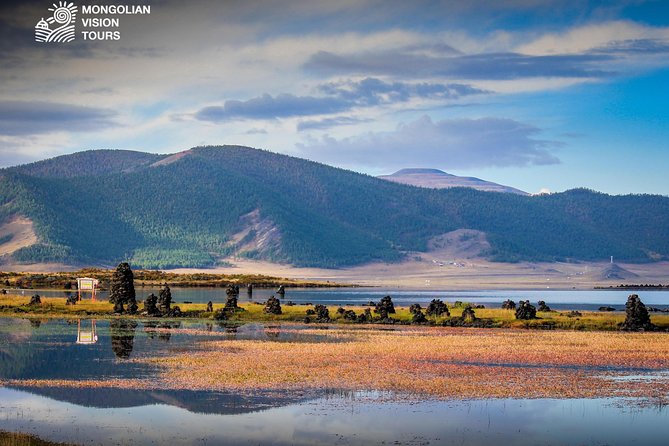
- Khorgo and Great White Lake add volcanic drama: You hike beside the lake and climb an extinct volcano at 2,240 meters.
- Ger accommodation keeps the trip close to local life: Countryside nights are in ger camps, nomadic family gers, or tents.
- Horse and camel rides are included: These are not optional extras added after you arrive.
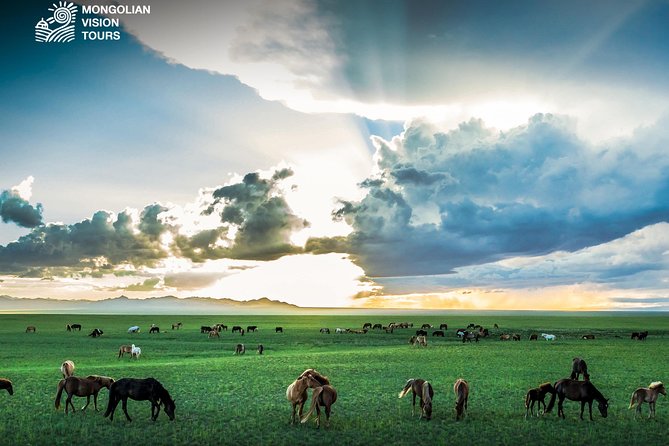
- Khustai protects Mongolia’s wild horses: The final full sightseeing stop is a chance to see Przewalski horses, known locally as takhi.
What the seven days are really like
This is not a relaxed hotel-to-hotel circuit. It is an overland trip through central Mongolia, with a guide present throughout and a 4WD van used outside Ulaanbaatar. The reward is access to places that are far beyond the capital, but the price is time in the vehicle.
The route covers ancient religious sites, rivers, forests, lava fields, volcanic lakes, desert-like dunes, and open steppe. That variety is the strongest reason to choose it. In a single week, you get a broad introduction to Mongolia rather than one narrow region.
You start at 8:00 a.m. from Mongolian Vision Tours GuestHouse in central Ulaanbaatar. Arrival and departure transfers are included, but accommodation in Ulaanbaatar is not, so you will need to arrange your own hotel or hostel before and after the countryside portion.
Other trips worth a look in Ulaanbaatar:
- From Ulaanbaatar: Genghis Khan Statue NationalPark CamelRide
★ 4.8 · 353 reviews - Genghis Khan Statue Day Tour+National Park+Camel Ride+Eagle
★ 4.5 · 261 reviews - From Ulaanbaatar: Central Mongolia Guided 3-Day Tour
★ 4.6 · 186 reviews
Day 1: The long road to Karakorum
The first drive runs about 365 kilometers from Ulaanbaatar to Karakorum, also written as Kharhorin. This is the longest listed driving day, and it sets the tone for the whole trip. You will spend many hours looking out at Mongolia’s open country, with few fixed landmarks and long stretches between settlements.
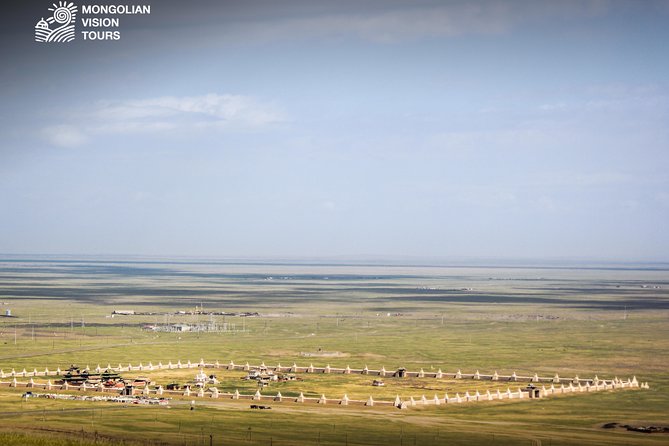
Karakorum was the former capital of the Great Mongolian Empire in the 13th century. Very little of the original city remains, so you should not expect a preserved medieval center. The value is in the setting and the historical connection. This was once the political center of an empire that reached across much of Asia.
The day includes a stop at Kharhorin Hunsnii zah. The name refers to the local food market, adding a more everyday note to a day otherwise centered on imperial history. It is a useful contrast: Mongolia is not only ancient capitals and sweeping views, but also ordinary local commerce.
The first night is in countryside accommodation, either a ger camp, a nomadic family ger, or a tent. A ger is a round felt-lined dwelling designed for Mongolia’s mobile pastoral life. It is simple rather than luxurious, and that simplicity is part of the appeal. You should expect a very different night from one in Ulaanbaatar.
Day 2: Orkhon Valley and Ulaan Tsutgalan Waterfall
The next stage covers about 200 kilometers from Karakorum into the Orkhon Valley. This is one of the most rewarding parts of the route because the scenery changes from open country to river valleys, meadows, forest, and mountain edges.
The main sight is Orkhon Waterfall, formed where the Ulaan and Orkhon rivers meet. Locals may call it Ulaan Tsutgalan. The waterfall is not just a quick photo stop. Its setting among the broad valley and surrounding greenery is what gives it appeal.
You will have time to appreciate the scale of the Orkhon Valley, an important part of central Mongolia’s cultural and natural story. The area is linked with nomadic life, so this is one of the better places to notice how people use the land for herding and seasonal movement.
The included meals matter here. Lunch, dinner, and breakfast are provided according to the schedule, which reduces the need to search for food in remote areas. One and a half liters of drinking water per person per day is also supplied. I would still treat that as a minimum, especially if you are hiking or riding.
Day 3: Forest trails to Tuvkhun Monastery
From the Orkhon Valley, you drive about 70 kilometers toward Tuvkhun Monastery, also known as Tövhön Hiid. Reaching the monastery involves trekking through mountains and forest, so this is not a simple vehicle-accessible attraction.
Tuvkhun has a strong connection to Zanabazar, regarded as Mongolia’s first religious leader. He created the monastery in the 17th century, and the location gives the site much of its character. The climb through the trees makes the visit feel removed from the roads and settlements below.
This is a good day for anyone who prefers cultural sites with a physical setting rather than buildings viewed from a parking area. You get a walk, a mountain environment, and a religious site in one stop.
The practical point is footwear. The provided information does not specify the length or difficulty of the trek, so sturdy shoes are sensible. You should also be ready for uneven ground and changing weather. The tour includes sightseeing and guiding, but it is not designed as a fully accessible vehicle-based visit.
A completely different kind of day out:
- Ulaanbaatar: Small Group 3-Day Best of Central Mongolia Tour
★ 4.1 · 171 reviews - Terelj national park transport /Best price tour
★ 4.7 · 135 reviews - Ulaanbaatar: Chinggis Khaan Statue and Turtle Rock Day Tour
★ 4.7 · 132 reviews - BEST 5* Chinggis Khaan Airport UBN to Ulaanbaatar Transfer Taxi
★ 5.0 · 116 reviews
Day 4: Hot springs and volcanic country
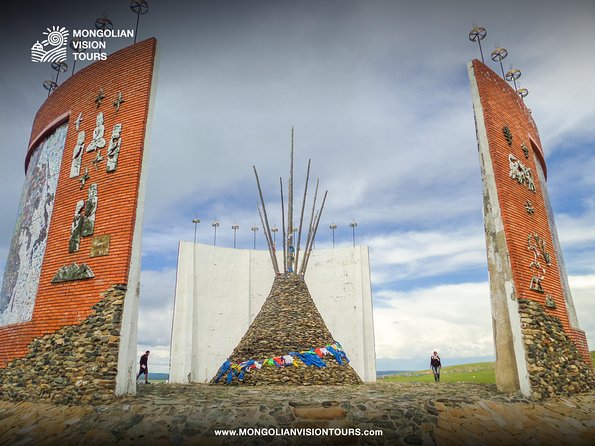
The fourth day moves about 190 kilometers toward Khorgo-Terkhiin Tsagaan Nuur National Park in Arkhangai Province. The park was created by volcanic activity, and that geology shapes both the lake and the surrounding scenery.
Terkhiin Tsagaan Nuur means Great White Lake. Its open water, high-country setting, and volcanic origin make it one of the route’s major natural sights. The drive from the hot spring area to the national park also gives you another long transition between regions.
The scenery here feels different from the Orkhon Valley. Instead of focusing on a river and waterfall, you are moving into a volcanic zone with lake views, lava formations, forest, and mountain slopes. That change helps explain why this tour earns its heartland name. It is not one repeated view all week.
National park entrance fees are included, so you are not left paying separate charges at each major natural site. Your countryside lodging and meals continue in the same basic style. Ger camps can be comfortable and atmospheric, but they are not a substitute for a city hotel. If private facilities are important to you, check the exact accommodation arrangements before booking.
Day 5: Hiking Great White Lake and climbing Khorgo
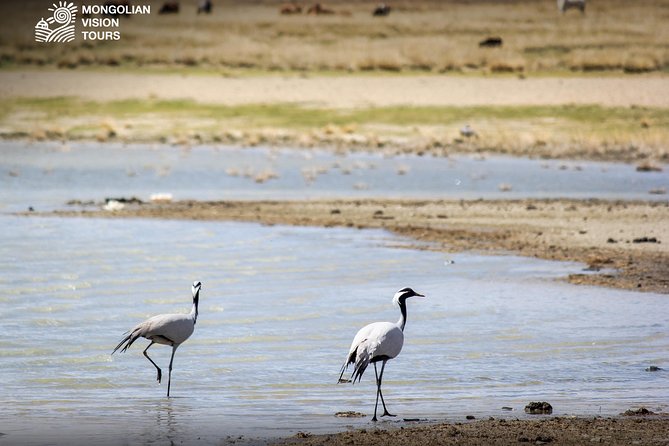
Day five stays in Terkhiin Tsagaan Nuur National Park. You hike along the lake shore, then visit Khorgo, an extinct volcano rising to 2,240 meters.
The walk beside Great White Lake is likely to be the most peaceful part of the trip. The setting gives you time away from the vehicle and lets you see the lake from ground level rather than only through a window. The provided schedule does not give a hiking distance, so your guide will be important in setting the pace.
The climb to Khorgo adds more effort and a wide view across the volcanic country. From the top, you can see lava flows covered with forest and the lake beyond. This is one of the tour’s best combinations of geology and scenery: the volcano explains the lake, while the hike gives you a clear view of both.
At 2,240 meters, Khorgo is not an extreme mountain climb, but it is high enough for weather and exertion to matter. Bring layers and shoes with a good grip. You should also keep some energy in reserve, since the trip continues the following day with another long drive.
Day 6: Great White Lake to Khugnu Khaan
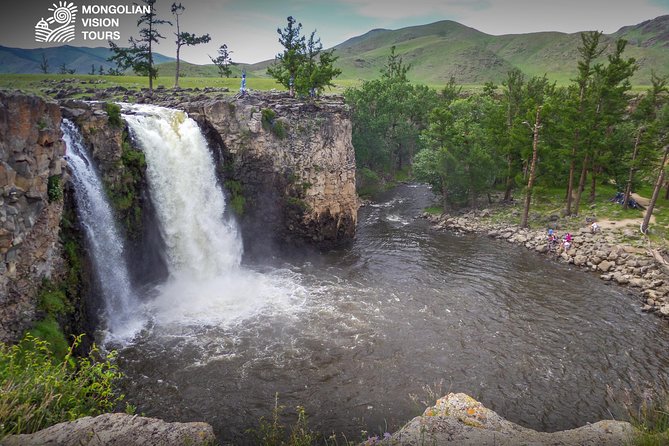
The sixth day covers roughly 290 kilometers from Great White Lake to Khugnu Khaan Natural Reserve. It is another substantial road day, but the destination offers a remarkable mix of scenery.
Khugnu Khaan brings together mountains, forest, steppe, desert-like ground, and sand dunes. The change is especially striking after the lake and volcano country. This is where the included camel ride becomes particularly fitting. Riding a camel over the dunes gives you a slower way to experience the area and a useful taste of how varied central Mongolia can be.
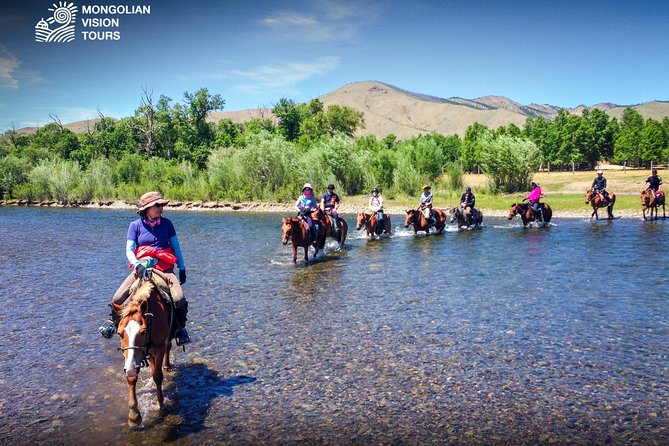
A camel ride is included in the tour price, along with a horse ride. The exact timing and length of each ride are not specified, so you should not assume that either one is a full-day expedition. Still, having both included is valuable. Many tours charge separately for these activities, or offer them only as optional add-ons.
The route description also highlights horse trekking toward the remote Eight Lakes through the historic Orkhon Valley. That sounds like one of the most distinctive parts of the wider experience, but the day-by-day schedule does not specify how many hours you ride or exactly where it fits. If horse trekking is your main reason for booking, ask Mongolian Vision Tours for the precise riding plan before you pay.
Day 7: Takhi horses at Khustai National Park
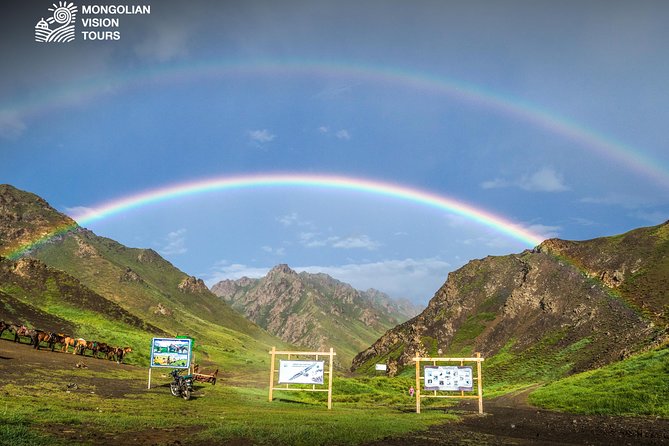
The final day runs about 280 kilometers back to Ulaanbaatar, with a stop at Khustai National Park. The park is known as a home of Przewalski horses, called takhi in Mongolian.
The takhi is the only surviving wild horse species in the world, making this more than a standard wildlife stop. Seeing them is never something a tour can guarantee, since animals move freely, but the park is specifically chosen for the chance.
Khustai also provides a final change of scenery before the return to the capital. After religious sites, waterfalls, forests, volcanoes, a lake, and dunes, the wild horses give the trip a clear closing point. You finish with a living part of Mongolia’s natural heritage rather than one more monument.
The return drive is long. This is not a day for a leisurely late departure, and you should avoid scheduling a flight immediately after the tour ends. The activity returns to the original meeting point in Ulaanbaatar, but the supplied details do not promise a specific arrival hour.
Ger camps, meals, and road comfort
The accommodation is one of the tour’s most authentic features and one of its main compromises. In the countryside, you sleep in ger camps, a nomadic family’s ger, or tents. These arrangements bring you closer to Mongolian daily life, but standards can vary from one night to the next.
You receive six breakfasts, seven lunches, and six dinners. That covers the countryside schedule well, and it is especially useful where restaurants are scarce. Alcohol is not included, and hotel extras, laundry, telephone calls, and bar bills are your responsibility.
Transport is by 4WD van in the countryside and by bus in the city area. The vehicle choice makes sense for rough roads, but no 4WD can turn Mongolia’s tracks into highways. One direct review gave the trip four out of five and praised the splendid sights and carefully chosen places, while noting that the long drives take some getting used to. That is the fairest way to frame the experience.
Is the $862.11 price good value?
At $862.11 per person, the price is reasonable for what is bundled into seven days of remote travel. You receive transport, a guide at all times, countryside lodging, meals, park fees, sightseeing, drinking water, a horse ride, and a camel ride.
The value is strongest if you would otherwise have to arrange a separate driver, guide, accommodation, food, and park entries. Mongolia’s distances make independent planning more complicated than simply connecting trains or buses between towns. A group tour also spreads the cost of the 4WD vehicle and guide.
The price does not include your Ulaanbaatar hotel or hostel, international airfare, visa fees, insurance, alcoholic drinks, gratuities, or extra services. You should add those costs before comparing this tour with a shorter package.
The group limit is 24 people. That is small enough to be manageable, but it is not a private journey. If your group fills to the maximum, vehicle comfort and flexibility may be limited. Group discounts may help reduce the per-person cost for larger parties.
Who should book this route?
I would recommend it if you want a broad first look at Mongolia and accept that the road is part of the experience. It suits people who enjoy natural scenery, basic accommodation, cultural sites, light trekking, and unusual forms of transport.
It is particularly good for you if:
- You want to combine history, religion, wildlife, and outdoor scenery.
- You like the idea of staying in gers rather than hotels every night.
- You want horse and camel rides included in the cost.
- You have only one week for central Mongolia.
- You are comfortable with long drives over rough roads.
I would hesitate if you need polished hotels, short transfers, a fixed arrival time, or a highly detailed daily activity schedule. The route is full, and the long distances can be tiring. The tour’s one available rating was four out of five, which fits the overall picture: the sights are excellent, but the roads require patience.
Confirmation is sent within 48 hours, subject to availability. The tour allows service animals, is near public transportation, and most people can participate, but the forest trek, lake walk, volcano climb, horse ride, and camel ride mean you should consider your own mobility and comfort.
Should you book the Mongolian Heartland tour?
Book it if you want variety more than comfort. In seven days, you reach Karakorum, Orkhon Waterfall, Tuvkhun Monastery, Great White Lake, Khorgo Volcano, Khugnu Khaan, and Khustai National Park. Few short tours cover such a wide slice of central Mongolia.
Before booking, ask for two details: the exact arrangements for the Eight Lakes horse trek and the expected daily driving times. If those answers suit you, the $862.11 price offers a practical way to see Mongolia’s heartland without organizing every remote transfer yourself. Free cancellation is available up to 24 hours before the start time, which gives you some room to confirm those final details.
FAQ
Where does the tour start?
The tour starts at Mongolian Vision Tours GuestHouse, WW77+F53, SBD, 1 khoroo, Ulaanbaatar 14251, Mongolia.
What time does the tour start?
The stated start time is 8:00 a.m.
Where does the tour end?
The tour ends back at the original meeting point in Ulaanbaatar.
Is transportation included?
Yes. Arrival and departure transfers are included. Countryside transport uses a driven 4WD van, while bus transport is used in the city area.
Is accommodation in Ulaanbaatar included?
No. You must arrange your own hotel or hostel accommodation in Ulaanbaatar.
Where do you stay in the countryside?
Countryside lodging is provided in ger camps, a nomadic family’s ger, or tents.
Are meals included?
Yes. The package includes seven lunches, six dinners, and six breakfasts.
Are horse and camel rides included?
Yes. The tour includes both a horse ride and a camel ride. The supplied details do not state the exact length or timing of either activity.
Can you cancel for a full refund?
Yes. You can cancel at least 24 hours before the local start time for a full refund. Changes or cancellations made less than 24 hours before the start time are not accepted or refunded.
Just added in Ulaanbaatar
- 7 Day White stupa Gobi Orkhon valley Central Mongolia★ 5.0 · 1 review
- Ulaanbaatar: Mongolian Bökh Wrestling Tournament Experience★ 5.0 · 1 review
- Ulaanbaatar Signature Tour – Mongolia’s Capital in One Day★ 4.3 · 3 reviews
- Ulaanbaatar: Chinggis Khaan Museum Highlights Private Tour★ 5.0 · 2 reviews
- Ulaanbaatar: Chinggis Khaan Equestrian Statue – Terelj NP★ 5.0 · 1 review
- Ulaanbaatar: 4-Day Central Mongolia Winter Tour★ 5.0 · 3 reviews
- UB Walk: Discover a Side of Ulaanbaatar Most Travelers Miss★ 5.0 · 2 reviews
- Private Transfer between New Ulaanbaatar International Airport and Ulaanbaatar★ 5.0 · 4 reviews
7-Day Experiences, compared.
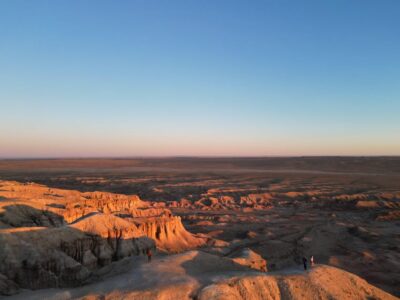
7 Day White stupa Gobi Orkhon valley Central Mongolia
Read our review →Browse the lists this tour appears in